An Act of Remembrance: Amy Hubbleday’s Husband

Occasionally, you strike gold when researching your family history. Recently, I came across a treasure trove of biographical records of soldiers who had died in World War 1. I wasn’t expecting to find anything related to the Hubbledays, but I was wrong. 

The incredible power which search engines now possess led me to a photograph of a fallen soldier called Thomas Butt. I was vaguely aware of the name in the family tree but had never gone further than recording him as the husband of Amy Hubbleday. She was my great-grandfather’s sister, in other words my great grandaunt but I had no idea that her husband had ever been a soldier.

The document which revealed his hitherto hidden history is called De Ruvigny’s Roll of Honour. It was begun in 1914 by the Marquis de Ruvigny, a British genealogist, who intended to collect biographical details of all those who died in service to their country. The patriotic fervour when war was declared meant that he, like most people, thought that hostilities would soon be over. In the event, his efforts were defeated by the horrific scale of deaths (nearly a million British and Commonwealth military personnel). The project came to an end with the details of just under 26,000 deaths, around 3 per cent of the total. The motivation for the project was set out in the foreword:

Thomas Butt’s entry is on page 44 of Volume 3 of the Roll of Honour. There are 19 men listed on that page: four officers, including one with the Victoria Cross; and 14 other ranks, including a lance-corporal from Birmingham in Thomas’s regiment who had been awarded the Military Medal. Several of the entries contain only the barest details of the man being remembered but Thomas’s is one of the most detailed. As well as precise details about his life, it contains the following words from a comrade: “I can tell you he was one of the best and bravest soldiers we had, and I shall miss him very much, and all of his platoon and myself send you their deepest sympathy.”

Given the small percentage of those killed whose names are recorded, it is remarkable that Thomas Butt made it into the publication. Even more remarkable is that his entry is one of only 7,000 to include a photograph. I am very grateful and moved that Amy Hubbleday or Thomas’s brothers ensured that his life and sacrifice were recorded for posterity. The details in the Roll of Honour have spurred me on to research further into his eventful life as my act of remembrance. Although he was not a Hubbleday, I am pleased and proud to share this story of a brave man.

Thomas’s Early Life

Thomas was born in Aston, Birmingham on 17 December 1880. His father, William Butt, was a carpenter married to Emma Ironmonger, a thimble maker. The couple already had two other children: William born in 1877 and Arthur born in 1879. Tragically, both parents died within a year of each other when the boys were still very young. Their father died of typhoid followed by tuberculosis and their mother from tetanus.

Aged only 4, 6 and 8 the boys were placed in Sir Josiah Mason’s orphanage in Erdington. This institution was an imposing building which catered for 400 children. It had been built by Sir Josiah in the 1860s when he had made a fortune as a manufacturer of steel pen nibs. It seems to have had a good reputation as a school and was known to be strict. For its time, children were treated humanely although teachers gave them numbers rather than using their names. The trust deed gives a flavour of the approach adopted by the school’s management.

Those who are admitted to the Orphanage are to be lodged, clothed, fed, maintained, educated, and brought up gratuitously at the exclusive cost of the Orphanage income. Proper arrangements shall be made by the trustees for the instruction of the children, having due regard to their respective ages and capacities in reading, writing, arithmetic, geography and history. All the children shall be brought up in habits of industry and, as far as possible, the girls be instructed in sewing, baking, cooking, washing, mangling, and in all ordinary household and domestic duties. The children shall be carefully instructed in the knowledge of the Holy Scriptures in the authorised English version.

This detail from a photograph taken by Nicklin, Phyllis (1960) Mason Orphanage, Erdington, Birmingham is reproduced under a Creative Commons licence. http://epapers.bham.ac.uk/623/

Children left the institution when they were 14 and Thomas went to live with his older brothers at 6 Back Lupin Street in Aston. He was there from around 1894, working in one of the many factories in the area, probably as a brass burnisher.

Boer War

In January 1899, Thomas joined the army. His attestation papers show that he signed up with the 5th Battalion of the Royal Warwickshire Regiment which was a reserve militia force.  He was just under 5 feet 4 inches and weighed 119 pounds (54 kgs or eight and a half stone.) Enlisting in the militia was a well-known way of gaining extra money while continuing to have a civilian job. Recruits were required to do 56 days of initial training and then to attend a training camp for three or four weeks once a year.

However, in May 1900, men in the militia were called up for regular army service as Britain needed to reinforce its troops in South Africa. Thomas was assigned to the 2nd Battalion and a few months later found himself playing an active part in the Boer War. By August 1901, he was entitled to the Queen’s Medal with four clasps indicating the campaigns in which he had taken part: South Africa 1901; Belfast; Cape Colony and Orange Free State.

The regiment’s fighting strength had been greatly reduced by cases of malaria and it was decided to send it to Bermuda to guard Boer prisoners of war. Thomas eventually returned to England in December 1902 and was reposted back to the militia. He had an honourable discharge from the regiment in 1904.

Married Life

In the same year that he left the army, he married Amy Hubbleday. She had been born in 1884 and was the youngest daughter of nine children raised by William Robert and Mary Ann Hubbleday. William Robert, the Hubbleday from whom all living Hubbledays can trace their descent, had been a soldier in the 1860s but had left the army in 1870 and settled in Birmingham as a bootmaker. After his wife’s death from heart disease in 1893, he had remarried in 1900 to Rose Langston, a domestic servant 15 years his junior. 

By the time of the 1901 Census, all of his children apart from Amy had married and left home. Aged 16, she was working as a pin machinist and living with her father and her new stepmother at 6 Ladywood Place. We don’t know where or how Amy and Thomas met but it is possible that they were working in the same factory. For certain, they were both working in the bedstead trade at Reeves & Co in central Birmingham a few years later: he as a brass burnisher and she as a polisher.

Thomas and Amy lived in Alexandra Street, Ladywood and had three children over the next ten years: Thomas in 1907; Edward in 1912 and Florence Beatrice on 25th June1914. Three days after Florence’s birth, Archduke Franz Ferdinand of the Austro-Hungarian Empire was shot dead in Sarajevo by a Bosnian Serb, triggering war with Germany.

World War 1

Thomas did not enlist again straight away although thousands of other Birmingham men were volunteering at mass recruitment events. Nevertheless, before the year was out, he returned to his old regiment and signed new attestation papers on 17th December, his 34th birthday.

Within a month, he was in France with the 1st Battalion of the Royal Warwickshire Regiment, part of the British Expeditionary Force trying to counter the German offensive in France and Belgium. By the beginning of 1915, the two armies faced each other in trenches which extended 400 miles across Western Europe. Much of the fighting that year focused on the Ypres Salient, an area of high ground held by the Germans. 

The second Battle of Ypres began on 22nd April and Thomas’s battalion received orders to attack on 25th April. They went over the top at 4.30am but were unable to make much headway. By the time the attack was over at 7am, the regiment was at half strength, having lost 17 officers and 500 other ranks killed, wounded or missing. Thomas received a bullet wound in the head and was invalided home from a hospital in Rouen.

The entry in the Battalion’s War Diary for the day that Thomas was seriously wounded.

He recovered and was posted back to France, probably sometime in 1916. Plans were being made for a ‘big push’ in the summer north of the River Somme and the 1st Battalion was being readied for action. Five days of bombardment by British artillery began in the last week of June intended to soften up the German defences. Gas was released by both sides and there were frequent casualties during this period. The Battle of the Somme began on 1st July and 27 men, including Thomas, were wounded during the battalion’s attack on the German lines. This date has gone down as the bloodiest day in British military history as 57,000 men in all were killed or wounded with very little to show for it.

Thomas remained in the regiment and was promoted to lance-corporal. In April 1917, the 1st Battalion was stationed just outside Arras and was once again readying itself to make an attack.

Soldiers attacking near Arras in 1917. Image courtesy of the Imperial War Museum. Image: IWM (Q 5100)

The Battle of Arras is mostly remembered for the success of the Canadian Divisions in capturing Vimy Ridge. The Royal Warwickshire Regiment had less success in the part they were asked to play a few miles away at Fampoux in the Scarpe Valley. The War Diary for 11th April, the day that Lance-Corporal Thomas Butt was one of 35 men to die, described the first day of action thus:

The enemy shelled our Assembly positions heavily and we had many casualties before starting. The enemy’s M.Gun fire held up our attack almost from the start and the Brigade consolidated a line about 400 yards in front of Assembly position. Both Brigades on our right and on left were held up also by M. Gun fire. Enemy put up a heavy barrage on Assembly positions and vicinity.

So, Thomas was almost certainly killed by shelling before the attack had even started. His name is inscribed on the Arras Memorial at Faubourg-D’Amiens Cemetery. It is one name among 35,000 allied military personnel whose bodies were never recovered from the battleground around Arras.

One of the best-known war poets, Siegfried Sassoon, was wounded in the battle five days after Thomas’s death. He wrote a famous short poem called ‘The General’ which mentions Arras and expressed a common sentiment at the time.

After Thomas’s Death

Amy Hubbleday was able to claim a pension from the government worth 26 shillings and 3 pence a week.  An allowance was also provided for children up to the age of 16: ten shillings for the first child, seven shillings and sixpence for the second and six shillings for any further children. A few years after the war, she was sent the medals that her husband was entitled to: the 1914-15 Star, the British War Medal and the Victory Medal. The families of soldiers killed in action also received a bronze plaque, popularly known as the ‘dead man’s penny’ because of its similarity in appearance to the much smaller penny coin. It was inscribed around the edge with the words: ‘He died for Freedom and Honour’.

By this time, however, Amy had remarried, forfeiting her widow’s pension. In January 1919, she married Frank Currall, a paving labourer, who was a year younger than herself. She had three young children to care for and although Thomas’s death was honoured by his country, it is quite likely that she may have felt very differently about his sacrifice.

Kendrick Randolph Frank Currall, to give him his full name, had also been a soldier in the Royal Warwickshire Regiment. He had joined the 1st Battalion in 1905 and served six years in India and Ceylon. However, his story is less inspiring than Thomas’s. He was discharged with ignominy in 1913 after being sentenced to 56 days’ detention for gross misconduct. More shockingly, before joining the army, he had been sentenced to three years’ imprisonment in 1902 for a serious sexual assault on a girl with a group of other men.

Perhaps Amy didn’t know or perhaps he was a reformed character. Their marriage seems to have lasted as they were still together when the 1939 Census was taken in preparation for another war. Sadly, her son, Edward had died in 1922 aged ten, but the other two children married and lived into their eighties. Amy died in 1955.

I would love to know if Thomas’s story was kept alive in the family. I wonder if his children and those that came after them ever read the memorial in De Ruvigny’s Roll of Honour.

The image at the beginning of this blog showing British and German trenches around Arras is reproduced with the permission of the National Library of Scotland.’ Map Images website.

Hubbledays in the 1921 Census

The 1921 Census was published yesterday (7 January 2022) and will be the last one to be made available until 2051. Normally, census information is released a hundred years after it was collected but, unfortunately, the 1931 Census was destroyed in a fire, and the 1941 Census was cancelled because of World War II.

Luckily for family historians, a National Register was taken in 1939 to help the government to (among other things) introduce rationing and a national registration identity card, but this was not a census in the strict sense of the word.

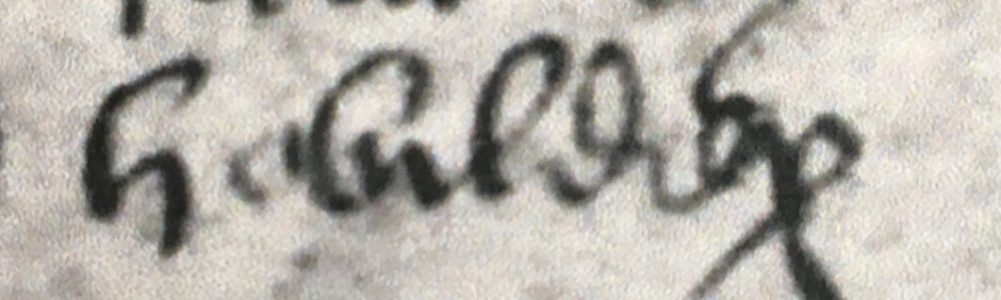
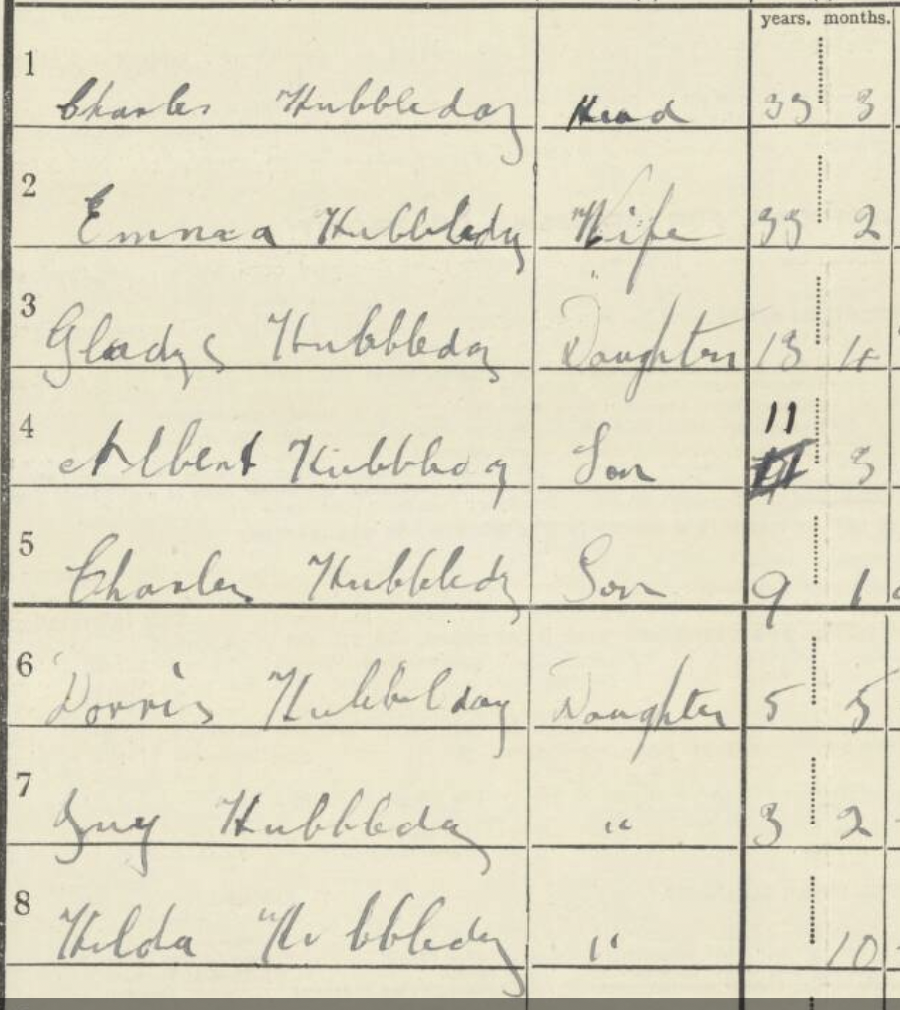
The 1921 Census contains the names of 23 people with the surname ‘Hubbleday’, all of them living in Birmingham. I was surprised to find that somebody called ‘Guy Hubbleday’ was listed as I had not come across this name before. After a little investigation, I discovered that the transcriber had misread the enumerator’s handwriting. ‘Guy’ was actually ‘Ivy’ Hubbleday, my aunty.

This is the record of my grandfather’s family with ages given in years and months. It is easy to see how ‘Ivy’ on line 7 was transcribed as ‘Guy”

A more serious error is that two Hubbledays are missing. Harriet Millen married Norman James Hubbleday in 1919 and had a son, Edward Charles Hubbleday, early in 1921 before the census was taken. However, neither Harriet or her son are recorded. This may have something to do with the fact that her husband was a private in the infantry stationed in Coventry at the time. She was probably living as a boarder somewhere close by and she and her son were somehow simply forgotten when the information was collected.

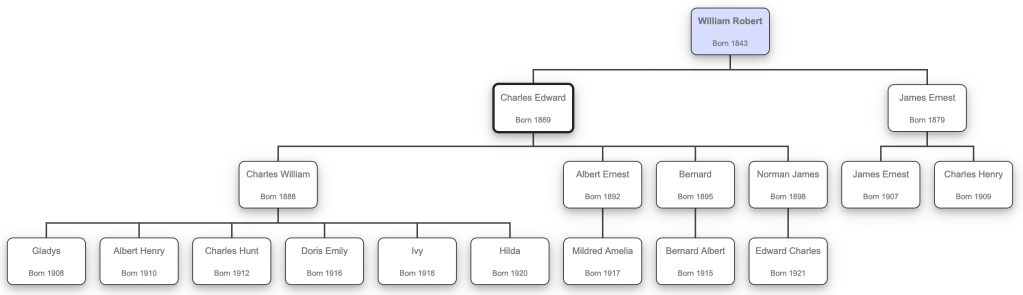
Four generations of Hubbledays are present in the census. William Robert Hubbleday, born in 1843, is the eldest, and all of the other Hubbledays are his direct descendants and their wives. My grandfather, Charles William, the grandson of William Robert, is shown married to Emma with six children: Gladys, Albert, Charles, Doris, Ivy and Hilda. A document from a hundred years ago sounds very old but I have a clear memory of these aunts and uncles who were born before or during World War I. My father, Kenneth, however, doesn’t appear because he wasn’t born until 1923.

Four generations of Hubbledays appear in the 1921 Census. Wives are not shown here only because of lack of space.

My grandfather’s three brothers, Albert Ernest, Bernard and Norman James, were all married by 1921 and each had one child. To complete the picture, my grandfather’s uncle, James Ernest, was married with two children.

If you have been following my previous blogs, you will not have been surprised to learn that all of the Hubbledays in the 1921 Census are closely related. You will also know how precarious the survival of the name has been. If William Robert hadn’t had any sons, the name would have been lost with his death in 1928.

The name is rare. For comparison, I have listed the number of entries in the 1921 Census for a sample of more common names.

Smith – 549,901

Jones – 469,193

Williams – 299,024

Taylor – 252,167

Robinson – 135,810

Even a more esoteric name, such as ‘Clutterbuck’, has over 1,000 entries. A name similar to ours, ‘Hobday’, has nearly 2,000. There are only a small number of surnames which, like Hubbleday, have fewer than 100 entries.

To this day, the name remains rare as there are still only around 70 Hubbledays. The fact that we are all closely related makes this even more special.

VE Day

Featured

I am thinking quite a lot about families at the moment as I am about to become a grandfather for the first time. Seventy-five years ago both of my son’s grandfathers were serving in the Allied armed forces so the 2020 celebration of Victory in Europe Day is an appropriate time to write about them. Neither wanted to be a soldier but events sometimes override personal ambitions and plans. The war trampled across their lives and altered their futures. However, the way they dealt with the experience was shaped by the values they had learnt, at least in part, from their parents.

My father, Kenneth Hubbleday, was conscripted into the army as a 19-year old in 1942. He had left school at 14 and worked in the Post Office as a telegram boy delivering messages on a BSA Bantam motorbike. Much to his father’s annoyance, he left this steady job and went to work on Birmingham market for a friend of the family. In his spare time, he looked after his racing pigeons, went fishing and tinkered with a cherished BSA 350.

When he was called up, he spent an unhappy two months at Catterick where he had all of his money stolen by a fellow recruit before being posted to the Royal Armoured Corps. He was assigned the role of a gunner in a tank regiment and he detested it. Luckily for him, someone spotted that he was a fish out of water and, after only three weeks, he was transferred to the Royal Corps of Signals. He remained there for the next five years.

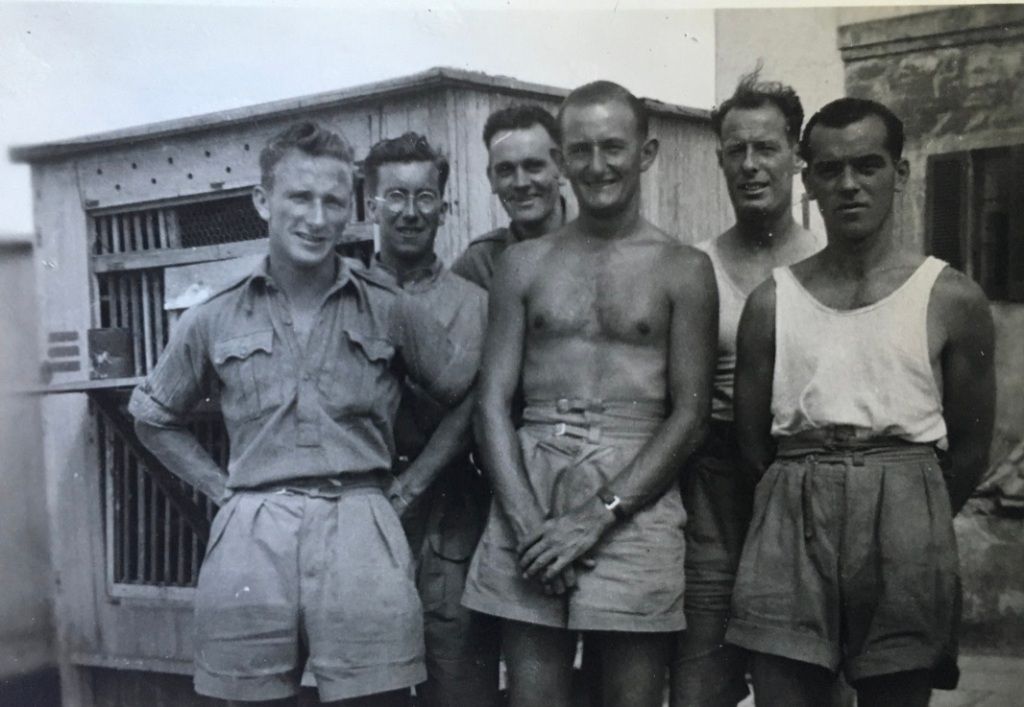
He was sent to North Africa and served as a despatch rider in the 8th Army under General Montgomery. He was then transferred to the carrier pigeon unit because of the knowledge his hobby had given him before the war. He had fallen on his feet and he was made a Lance-Corporal. The only thing which threatened to spoil this happy situation was when his officers began talking of parachuting them into the Balkans to work with resistance fighters behind the lines.

With the 8th Army in North Africa. Dad is on the left, wearing a shirt.

In the end this didn’t happen but something else occurred which was an ordeal he wouldn’t have expected. He stood up for his men when they were ordered unfairly by a corporal to do extra duties. He could have kept quiet but he didn’t and as a result he was punished for insubordination. He was sent to the ‘glasshouse’, the army’s prison, and had to endure being treated as a hardened offender. He refused to talk about it other than to tell me once that the guards were sadists. When he was released, his commanding officer gave him money to go for a drink and made it clear that he was appalled by the whole business.

After the allied successes in North Africa, the 8th Army crossed the Mediterranean to Sicily and began fighting its way northwards. The battle for Italy was a tough campaign and it took much longer than expected for the Allies to reach Rome and then the Alps. The Battle for Monte Cassino held up progress for the first five months of 1944. Eventually, dad’s unit reached Austria in 1945. He then spent his happiest time of the whole war waiting to be demobilised while living on a farm where he was allowed to exercise the horses.

He arrived back in England in 1947, having been the only one of his nine brothers and sisters to have been called up. His discharge papers contained the following testimonial written by the major who had been his commanding officer: He is a good, keen and efficient worker who is always willing to assist in any work in excess of his normal duties. A thoroughly decent and reliable character.

He spent the rest of his life as an electrician working for his sister Doris and her husband Ron out of premises on the Stratford Road in Shirley. He was a quiet and thoughtful man with many practical skills and anyone who knew him would have recognised the truth of the army’s testimonial. Very sadly, he died of pancreatic cancer in 1985 when he was only 62.

– – – – – – – – – – – – – – – – – – – – – – – – – – – – – – – – – – – – – – – – – – – – – – – – – – – – – – – – – – – – – – –

The account that follows of my son’s other grandfather is based on some remarkable research which my brother-in-law, Chris Rowan, has done. I have produced only a brief summary of a detailed history which he has written.

My wife’s father was Ignacy Romaszko who was born in 1915, two years before the Russian revolution, in a small village in the west of tsarist Russia. In 1921, the area became Polish and that is how Ignacy thought of himself. His parents were peasants but his father was a skilled carpenter and had worked in St Petersburg to earn enough money to buy a small farm.

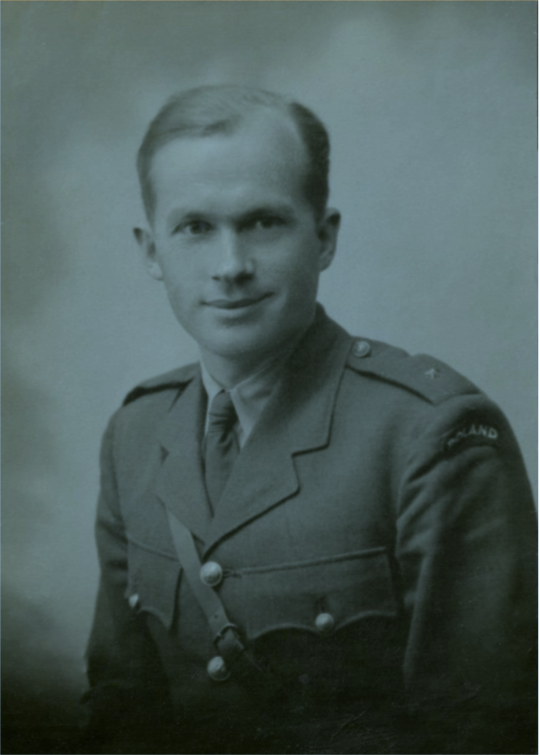
Ignacy won a scholarship to a college in Vilnius where he trained to be a teacher, graduating in 1935. He then began two years compulsory military service followed by service in the reserves. On September 1st 1939, Nazi Germany invaded Poland and Ignacy, who was now teaching in Vilnius, was called up for active duty. He returned home briefly to pack his bags before going back to defend the city with the 1st Legions Infantry Regiment. This was the last time he was to see his family or homeland.

Ignacy gave this photograph of himself to his family when he saw them briefly after being called up for active service in 1939.

The Polish reservists were heavily outnumbered by the German forces and short of heavy weapons. It was decided that they should evacuate to the neutral country of Lithuania, where they were interned. Meanwhile, Soviet Russia had invaded Poland from the east and begun a systematic extermination of officers and intellectuals. Lithuania was forced to cooperate and in July 1940, Ignacy was put in a freight wagon on a train and sent to the first of several Russian prison camps. His final destination in June 1941 was a forced labour camp on the Kola Peninsula, north of the Arctic Circle.

The conditions were inhumane and Ignacy was fortunate that within a month of arriving at the camp, Russia was invaded by Germany and came over to the Allied side. The imprisoned Polish soldiers were released but continued to be mistreated in the chaotic circumstances of the next few months. Eventually, a Polish army was reconstituted under General Anders, a former Polish cavalry commander, and Ignacy was appointed a platoon commander. After many months of wrangling between Russia, Poland and Britain, ‘Anders’ Army’, as it became known, moved to Uzbekistan and then to Iran where Britain wanted them to defend the oilfields.

In May 1942, Ignacy was transferred to Palestine, which was under British control, and assigned to the 3rd Carpathian Rifles Division. This was at a time when Britain feared that German forces in North Africa might overrun the British and capture the Suez Canal. However, this didn’t happen and at the beginning of 1943, Britain recruited Polish soldiers to join the RAF. Ignacy was selected and shipped to Greenock, Scotland in June. He was trained as a navigator and finished the war as a Flying Officer and the Adjutant at the Polish Air Force Apprentices School, RAF Halton.

Ignacy towards the end of the war when he was based at RAF Halton.

After the war, Poland became part of the Soviet Republic and it was dangerous for Poles in exile to return since they were treated as traitors by Moscow. Ignacy made a new life in England and retrained as a teacher. At the end of his course, the Principal of Loughborough Training College wrote the following testimonial: He has wide experience of life and a resulting maturity of outlook. Of his character and personality one cannot speak too highly. He is most willing to co-operate, has an unusual courtesy of manner, and should prove a particularly acceptable colleague.

Ignacy changed his surname to Rowan to make it easier to fit in to his new homeland. He died of leukaemia tragically young in 1959 and links with his Polish family were gradually lost as the Cold War made communication impossible. In 2019, his son, Chris, managed to trace some branches of the family in Belarus and my wife and I joined him on a visit there. The Romaszko cousins were delightful and Ignacy had not been forgotten. Ironically, one of the cousins had been a colonel in the Russian army during the Cold War and his career had suffered because of his link with the West.

. . . . . . . . . . . . . .

The reunion was an emotional and uplifting occasion for all of us. Family ties are important and understanding something of your family’s history is important too. So tomorrow we will be remembering the past but, as a grandfather-in-waiting, I have written this blog for the future, for someone about to be born who will hopefully read it when he begins to wonder about the past that has helped to shape him.

7 May 2020

Cordwainers and Workhouses: Three Brothers in Victorian England

Featured

My third-great-grandfather, Robert Hubbleday, was born in 1813, two years before the Battle of Waterloo. His father and grandfather were both shoemakers. William Hubbleday (1755 – 1788), Robert’s grandfather, had arrived in London from King’s Lynn and lived in Petticoat Lane. William Hubbleday (1784 – 1854), Robert’s father, had deserted his family and served a month’s hard labour in Newington House of Correction. The deserted family consisted of Robert, his two brothers and a sister. They were brought up by their mother, Elizabeth, with the help, it appears, of a man called William Hodges.

When William deserted his wife, he left her to bring up four young children. She managed to do this successfully with the help of a man called William Hodges.

The eldest child was Mary, born in 1810, but there are no records of her after she was baptised which suggests that she probably died as an infant. This was not unusual; in the first half of the nineteenth century around 30 per cent of children died before they reached the age of five. The three brothers, David, William and Robert, on the other hand, left plenty of evidence of their existence. They all became shoemakers, married and lived relatively long lives. However, they were never far from the workhouse and although they had large families, girls outnumbered boys by two to one. Moreover, several of the boys died in infancy or did not marry. Of those that did marry, only one raised boys who went to on have healthy sons of their own. Consequently, the survival of the name remained precarious, especially as two of the brothers renounced it in favour of their stepfather’s surname.

David’s Life (1811 – 1891)

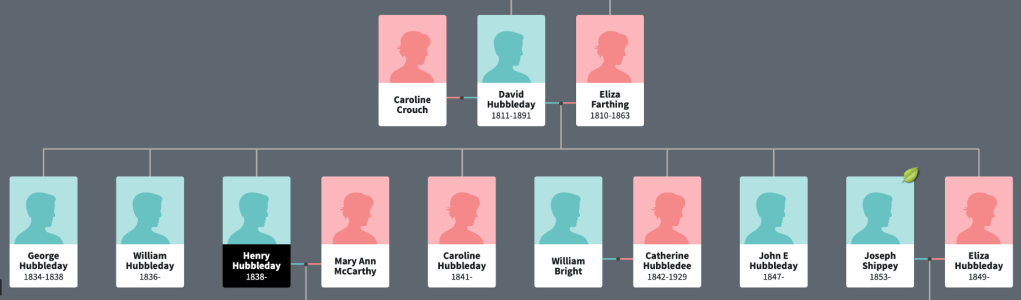
The eldest brother, David, was born in 1811 and remained in Southwark, London all of his life. He married Elizabeth Farthing in 1830 in the same church in Newgate that had witnessed his parents’ wedding. They had seven children before Elizabeth died in 1863. There were four sons but one died of smallpox and two left no records either because they did not marry or else died young. Only one of the sons, Henry, married. Although this marriage produced a grandson for David, the boy disappeared from the records after his birth in 1876. David had remarried by this time to a widow, Caroline Crouch, but there were no more children and so the name ‘Hubbleday’ disappeared from David’s line.

The eldest of the three brothers, David, had seven children with his first wife. Two of the daughters married but only one of the sons did. There were no children from David’s second marriage.

Throughout his life, David was variously described in the records as a ‘shoe maker’, a ‘boot maker’ or a ‘cordwainer’. The word cordwainer comes from the Spanish ‘cordovaner’, a worker of cordovan leather from Cordoba. This was fine leather and so the term cordwainer tended to denote that the person was more specialised or skilled than a straightforward shoe maker. The Worshipful Company of Cordwainers was a well-respected livery company and one of the oldest in the City of London but, sadly, there is no record of any Hubbleday belonging to it.

Shoe lasts like these were an essential part of a cordwainer’s equipment.

David lived a very long life and, like his father, finished his days in a workhouse. He was admitted to Christ Church Workhouse in the St Saviours Poor Law Union, Southwark in 1890 after the death of his second wife. He was probably in the infirmary, which would have provided him with a reasonable level of care. He died in the following year, aged 80. His name was recorded as David Hodges, alias Hubbleday, indicating his rejection of a surname which held little meaning for him.

The record of David Hubbleday’s death in 1891 (‘Taken out for Burial’) with the reference to his stepfather’s surname, Hodges.

Unlike David, his two younger brothers, Robert and William, both moved away from London for lengthy periods of time but returned to the capital towards the end of their lives. They lived in several towns and cities in the Midlands and the North and at one stage were residing in the same street in Dudley in the Black Country.

Their willingness to travel more extensively than any previous Hubbledays was almost certainly due to the arrival of the railways. By 1838, it was possible to go from London to Manchester via Birmingham in a day. Gladstone’s Railway Act of 1844 made it obligatory for railway companies to provide third-class accommodation at no more than a penny a mile so that journeys were within the reach of all classes. By the late 1850s, the trains were capable of travelling at 60 mph, reducing the time from London to Birmingham to under three hours.

An illustration published in 1839 of the entrance to Euston Station, the terminus of the London and Birmingham Railway.

William’s Life (1815 – abt. 1875)

William, born in 1815, left London as soon as he was in his twenties and went straight to the most important centre for shoemaking in the country: Northampton. In the 1840s, nearly ten per cent of that town’s population of around 20,000 were engaged in the trade. Upper Harding Street, where William lived, was occupied almost entirely by shoemakers. When his first child, Ann Elizabeth, was baptised in 1838, her page in the parish register at All Saints Church listed eight baptisms, five of which were for the children of shoemakers.

The name of this Wetherspoons pub in Northampton celebrates the town’s long history of shoemaking.

The 1830s saw an increasing use of small factories in the trade, with owners specialising in one aspect of the process rather than manufacturing a complete shoe. However, most shoemakers still worked at home in a room adapted as a workshop and they were famous for liking their independence. They enjoyed operating as small, one-man businesses and as they had to keep track of orders and be careful about standardised measurements, they were often more literate than other workers. It is notable that William signed his own name on his marriage certificate whereas his wife was only able to make her mark with a cross.

William was able to sign his name but his wife, the daughter of a tailor, was illiterate and simply put a cross on the marriage certificate.

In 1840, William and Elizabeth had a second daughter, Martha, in Northampton and then, at some point after this, left the town and moved to Dudley in Worcestershire. We know this because in 1843, they registered the birth of a third daughter, Mary Jane. William’s occupation was given as a cordwainer and he was living in Campbell Street, which was in Brockmoor near Brierley Hill. Two years later, his brother, Robert, registered the birth of a daughter, Betsy Elizabeth, and gave his address as the same street as William’s. It is very likely that they were living in the same house.

William and Elizabeth only stayed in the West Midlands for a few years. In 1845, they were back in London in Holborn where they had a son, William. In 1847, they arranged to baptise three of their children on the same day at Holy Trinity Church, Gray’s Inn Road.

William and Elizabeth Hubleday (sic) arranged to have their three unbaptised children, who had been born in Northampton, Dudley and London, all baptised on the same day in 1847 when they were living in Holborn. The fifth column helpfully gives their dates of birth. The sixth column shows that William was still working as a cordwainer.

William and Elizabeth were clearly restless spirits because three years later they were in Manchester. Perhaps somewhat surprisingly at this point in their lives, they got married three days after Christmas in 1850. They were living at 50 Silver Street in the centre of the city. Nowadays, it is a busy section of road backing onto the Britannia Hotel but in the early Victorian period was an area of back-to-back housing with closed courts and narrow alleys. The wedding took place in Manchester Cathedral, which was the parish church for the centre of the city.

The 1851 census shows that William and Elizabeth had had another daughter, Alice. They had chosen to drop the name ‘Hubbleday’ and were living as Mr and Mrs Hodges and all of their children were given this surname. The decision is an easy one to understand as William had been an infant when his father left home. It was his stepfather’s surname of ‘Hodges’ that would have meant more to him. The census gave William’s occupation as a shoe maker and listed three lodgers staying in the family home, all of them also shoe makers. One of William’s daughters, Elizabeth, who was only 12 years old was working as an ‘end mender’ in the cotton industry which, notoriously, depended on cheap child labour.

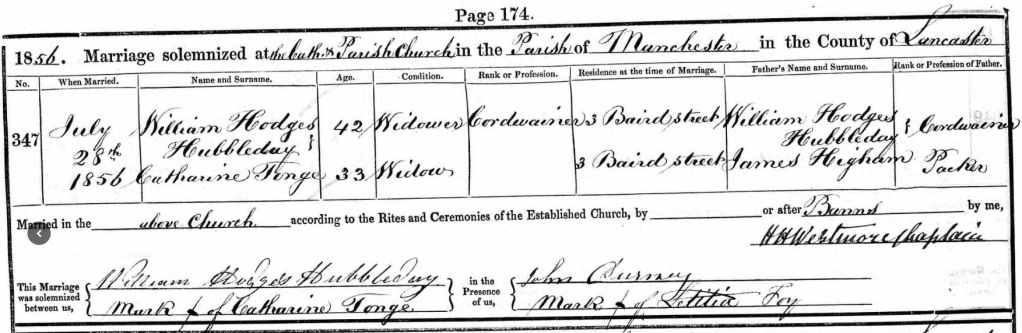
William’s wife, Elizabeth, died within a few years of the census, having had no more children. In 1856, William, as a widower, married a young widow, Catherine Tonge, who had four children. The marriage took place in the cathedral and William signed himself, ‘William Hodges Hubbleday’, and named his father also as William Hodges Hubbleday, a cordwainer. This appears to be an amalgam of his real father, William Hubbleday, and his stepfather, William Hodges.

William’s second marriage to a widow took place in 1856 in Manchester Cathedral. It shows William using the name of his stepfather, ‘Hodges’ and giving his father’s name as an amalgam of his real father and his stepfather.

A few years later, William was on the move yet again and left Manchester for London. He took his family back to the area he had known as a boy. Unfortunately, Catherine’s first experience of the capital was not a pleasant one as the family had nowhere to sleep and they had to resort to staying in Newington Workhouse for the night. Presumably, William was looking for lodgings because the next day Catherine was able to take her family out of the workhouse. Interestingly, she gave her surname as ‘Hubbleday’ despite having lived as Mrs Hodges for four years!

The page below from the Newington Workhouse register indicates the ages of Catherine’s family by showing which diet they were entitled to. Catherine was ‘5’, which was an able-bodied woman over the age of 13; Alice was ‘7’, which was girls aged from 9-13; Emily and Georgiana were ‘8a’, which was girls aged 2-5; and Hannah was ‘9’, which was infants. Alfred Tonge, Catherine’s youngest son by her previous marriage, was ‘4’, which was boys aged 5-9.

William’s second wife, Catherine, asked to be admitted to the Newington Workhouse with her family on 12 October 1859 immediately after arriving in London from Chorlton in Manchester.

By the time of the 1861 census, the family had moved north of the river and were living in Shoreditch, near where William’s grandfather had lived. William’s occupation was given as a cordwainer. His only son, born in 1845, does not appear in the 1861 census or any other records after the 1851 census so it is likely that he died as a boy. In 1871, most of the family were still together and that year’s census shows that Catherine’s son, Alfred, had adopted the surname ‘Hodges’ and had followed his stepfather, William, into the shoemaking trade as a cordwainer. His stepsisters, Emily and Georgina, were both book folders.

There is no record of William after this date but it is highly probable that he died in the 1870s as I have not been able to find him in the 1881 census. He would have been in his sixties but whether he was buried as a Hubbleday or as a Hodges, we cannot tell. The fact that he left no sons carrying the name ‘Hubbleday’ meant that, yet again, the continuation of our surname hung by a thread. It was only through the family of the third brother, Robert, that it survived.

Robert’s Life (1813 – 65)

At some point in his twenties, my third-great-grandfather, Robert, moved from London to the Black Country in the West Midlands. It is likely that his brother William was already there or it may have been Robert who made the journey first. The following description of the area from an 1851 guide book, Rides on Railways by Samuel Sidney, makes you wonder what made either of them think it was a good idea.

In this Black Country, including West Bromwich, Dudley, Darlaston, Bilston, Wolverhampton and several minor villages, a perpetual twilight reigns during the day, and during the night fires on all sides light up the dark landscape with a fiery glow. The pleasant green of pastures is almost unknown, the streams, in which no fishes swim, are black and unwholesome; the natural dead flat is often broken by high hills of cinders and spoil from the mines; the few trees are stunted and blasted; no birds are to be seen, except a few smoky sparrows; and for miles on miles a black waste spreads around, where furnaces continually smoke, steam engines thud and hiss, and long chains clank, while blind gin horses walk their doleful round. From time to time you pass a cluster of deserted roofless cottages of dingiest brick, half swallowed up in sinking pits or inclining to every point of the compass, while the timbers point up like the ribs of a half decayed corpse. The majority of the natives of this Tartarian region are in full keeping with the scenery – savages, without the grace of savages, coarsely clad in filthy garments, with no change on weekends or Sundays, they converse in a language belarded with fearful and disgusting oaths, which can scarcely be recognised as the same as that of civilized England.

In 1843, Robert registered the birth of his first child, William Robert, and gave his address as New Hall Street, which is in Princes End midway between Coseley and Tipton. His occupation was recorded as a boot maker. The mother’s name was given as ‘Mary Hubbleday, formerly Ward’. Two years later, when Robert was living in Campbell Street near Brierley Hill, Dudley, the same street as his brother William, he had another child, Betsy Elizabeth, and the mother’s name was given as ‘Mary Hubbleday, formerly Christy’. The confusion about the former names of Robert’s wife was because she had been married and then widowed before having children with Robert. She had been born as Mary Ann Ward and had married a William Christy in 1834 in Bethnal Green.

A map of the West Midlands conurbation showing the areas associated with the Black Country.

After the death of her first husband, Mary lived with Robert for several years before they married in 1847. They had moved from Dudley to Wolverhampton some time in the previous two years and the wedding took place in St Peter’s Collegiate Church in the centre of the town. The marriage certificate states that Robert was a cordwainer and that he was the son of W. Hubbleday, a cordwainer. Furthermore, the certificate possibly reveals that Mary Ann’s father was also a cordwainer. We can’t be certain about this because the registrar seems to have muddled her father’s name with that of her first husband! Neither Robert or Mary were able to write their names and instead both put a cross rather than signing the certificate.

By 1851, they were back in London and they had another son, Robert. They were living at 46 Eagle Street, Red Lion Square in Holborn, which was a more salubrious area than the Black Country. Unbeknown to them, for instance, Dante Gabriel Rossetti, founder of the Pre-Raphaelite school of painting, and his friends William Morris and Edward Burne-Jones, also lived in Red Lion Square in the 1850s.

A painting by an unknown artist of a typical street scene in Holborn in the nineteenth century.

However, it was an unhappy period for Robert and Mary as two of their daughters died and the family’s fortunes declined. They moved to Reading in Berkshire, presumably looking for work, and it was here that their last child, Jane, was born in 1855. However, by 1856, they were back in London, but south of the river in Southwark, and on 8 March they were all admitted to the Newington workhouse and listed as destitute.

The whole of Robert and Mary’s family were admitted to Newington Workhouse in 1856 when they were destitute.

It seems that Robert managed to find work quite quickly as he was able to bring his family out of the workhouse on 14 March. In the 1860s, they were north of the river again, living in Wilton Street in Finsbury, but Robert was becoming sick and was admitted to the famous St Bartholomew’s Hospital (Barts) in Smithfield. An 1850 guide to London praised the hospital because it ‘. . . gives relief to all poor persons suffering from accident or diseases, either as in-patients or out-patients. Cases of all kinds are received into the Hospital, . . . cases of urgent disease, may be brought without any letter of recommendation or other formality at all hours of the day or night to the Surgery, where there is a person in constant attendance.‘ Sadly, however, there was little that could be done for Robert and he died in 1865, aged 52, from peritonitis caused by stomach ulcers. He was buried on Christmas Eve at the City of London and Tower Hamlets Cemetery where his father had been buried.

The courtyard of St Bartholomew’s Hospital in London by Thomas Hosmer Shepherd, early 19th century.

Robert and Mary had had two sons and four daughters. Two of the daughters had died as young girls, and the other daughter and the two sons had left home by the time of Robert’s death. This left only the youngest daughter, Jane, still at home with her mother. As an impoverished widow of nearly 60 with a young girl to look after and before the days of state pensions or income support, the future was bleak. Their lives from this point onwards are reminiscent of depictions of the Victorian poor in the novels of Charles Dickens, such as Oliver Twist and Hard Times.

In 1867, Mary and Jane were admitted to the workhouse in Holborn, less than a mile from Charles Dickens’s home in Tavistock Square. This would have given some respite but was not a long-term solution, particularly for a young girl. Rather than risk her child becoming just one more street urchin surviving by begging and stealing, Mary gave her up. We don’t know exactly when this happened but it was probably soon after they had to leave the Holborn workhouse when Jane was aged twelve. At the time of the 1871 census, Jane was listed as an inmate of a home for destitute girls in Broad Street (now the Western end of High Holborn) in Bloomsbury.

A nineteenth-century map of Bloomsbury showing Broad Street where the refuge for destitute girls was located.

The home was funded by voluntary contributions and the girls were trained in household work so that they could be found places as domestic servants. As well as washing and cooking, they were taught needlework and how to make and repair their own clothing. The only condition for admittance was destitution.

An article in a business gazette from 1870 reporting on the organisation which ran the Broad Street refuge where Jane Hubbleday was living in 1871.

Although Jane had lost her father and, to all intents and purposes, her mother, she was probably better off as an inmate of the refuge than if she had stayed with her mother. She was looked after in a benevolent educational institution and was able to make a decent marriage to a Bethnal Green chair maker in 1873 when she was 18. She did not, however, escape from living perilously close to the poverty line. At the time of the 1881 census, she gave her occupation as ‘a cats meat purveyor’, which, surprisingly, was quite a common job. It involved collecting horses’ meat from the slaughterhouses and threading it on skewers to sell to cat owners. The writer of a magazine article in 1868 had this to say: . . . this branch of street trade numbers among it . . . women, who can just manage to crawl along from house to house with their scanty baskets of horseflesh. It is impossible exactly to state the number engaged in this business in our streets, but there must be many hundreds.‘  Ten years later, she was a widow and working at a factory in Tottenham. She remarried in 1892 to a labourer, George Bull, who was ten years her junior. The last record we have of her is the 1911 census when she was still in Tottenham, but apparently without her husband, and working as a charwoman.

During most of this time, Jane’s mother, my great-great-great-grandmother, was trying to eke out a living as a street hawker and rag sorter in central London.

In 1873, the admission register for St Luke’s Workhouse, Holborn listed Mary Hubbleday’s occupation as a rag sorter, a dirty and unhealthy job selecting rags to be used to make paper.

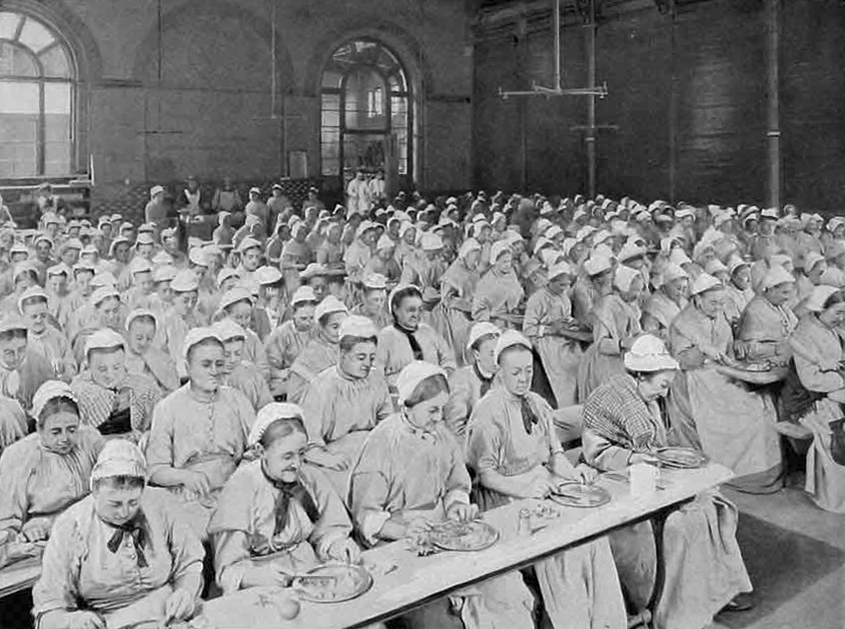
Mary endured a solitary downward spiral of destitution for an astonishing thirty years until her death in 1901 at the age of 91. She became well known in the workhouses of Holborn, Southwark and Bethnal Green, depending on them for food and somewhere to sleep, sometimes for months on end. She would have become very accustomed to repetitive manual work such as picking oakum just as her father-in-law had had to do when sentenced to hard labour in the House of Correction. Workhouses were designed to be forbidding places to discourage people from claiming poor relief. The huge wealth of the British Empire during Queen Victoria’s reign (1837 – 1901) did not soften the harsh living conditions of the working class. The elderly, infirm and unemployed often had little option but to embrace, as many of our ancestors knew from firsthand experience, the rigours of the workhouse. However, given Mary’s situation, the workhouse was quite probably more comfortable and secure than her life outside it.

A regimented mealtime for women in a London workhouse at the beginning of the twentieth century.

The story of the Hubbledays in nineteenth-century London has not been a happy one, marked, as it has been, by early deaths, illness, family break-up and poverty. The next blog will deal with the lives of Robert and Mary’s two sons who I have deliberately not mentioned other than to note their births in 1843 and 1851. They both looked to the army for a way to better their lives and their experiences merit a chapter to themselves. Events did not turn out as they, or we, might have expected but the survival of the Hubbleday name, at least, began to look more hopeful.

‘The Manchester Song’ in Elizabeth Gaskell’s 1849 Novel, ‘Mary Barton’.

From King’s Lynn to London

Featured

John and Mary Hubbleday, my sixth-great-grandparents, moved with their two-year old daughter, Mary, from Wisbech to King’s Lynn in around 1750, presumably to seek work although we don’t know in what trade. There were many to choose from as King’s Lynn was an important trading and fishing port and had a significant shipbuilding industry. Glass-making and brewing were also well established. Daniel Defoe famously said that the town was, ‘Beautiful, well built and well situated’. Mary gave birth to two boys after they moved to King’s Lynn and these sons were both baptised in the magnificent church of St Nicholas: Robert in 1751 and William in 1755. This blog is about their two quite different lives and how the name of Hubbleday almost disappeared.

The impressive 1627 font in the church of St Nicholas, King’s Lynn where my fifth-great-grandfather, William, and his brother, Robert, were baptised in the 1750s.
Image courtesy of Simon Knott from his website at http://www.norfolkchurches.co.uk

John Hubbleday’s new life in King’s Lynn was relatively short. He died aged 40 in 1759, leaving his widow, Mary, with three young children all under the age of eleven. She remarried two years later to a widower, Edmund Wallington, so Mary, Robert and William spent their formative years in King’s Lynn with a stepfather. The daughter, Mary, married as soon as she was 21 and remained in King’s Lynn with her new husband, Thomas Lake. However, the two sons, Robert and William, left the town as soon as they were adults and started to carve out new lives for themselves.

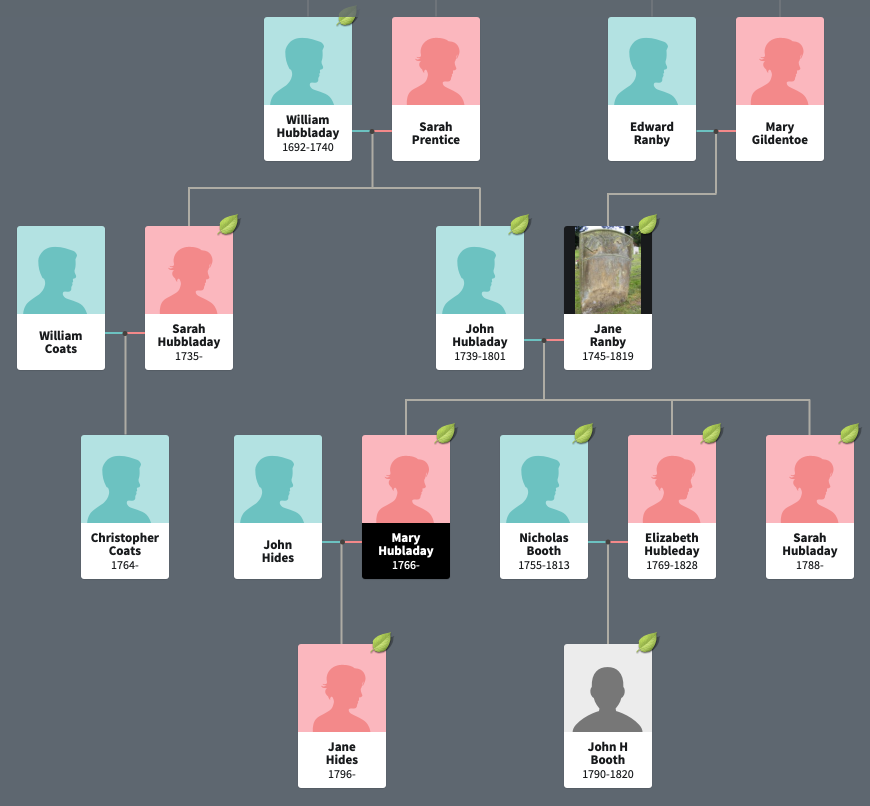
John Hubbleday married Mary Witten in Wisbech and they moved to King’s Lynn in around 1750. He died in 1759, aged 40, and Mary remarried two years later while she still had three young children: Mary, Robert and William. The family tree shows that the two sons went on to marry but we know nothing about their wives other than their names.

Robert went to work in Great Yarmouth and married Elizabeth Baker there in 1776. Two years later they were in Attleborough, midway between Norwich and Thetford, and Robert was the landlord of The Crown Inn on Church Street.

The Crown Inn, Attleborough in the 1960s. It is now a youth centre. There is more information about the pub on the website http://www.norfolkpubs.co.uk from which this image is taken.

Attleborough was on the main turnpike road through Norfolk which went from Norwich to London. Turnpikes were essentially toll roads which had been established by Acts of Parliament in the first half of the eighteenth century. The income they generated led to huge improvements in the quality of the roads and this opened up opportunities for would-be entrepreneurs. Robert went into business running a post-chaise service to Newmarket in Suffolk. Post chaises were small carriages owned by innkeepers who hired them out, with horses and post-boys, to people who wished to travel privately, rather than by stage-coach.

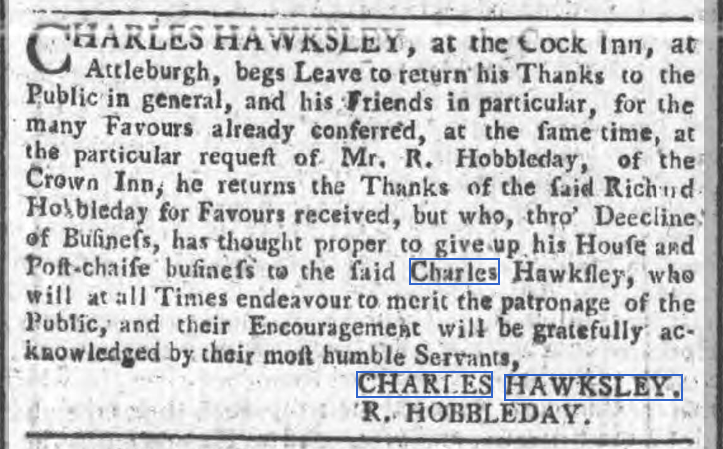
An advertisement which ran for many weeks in the Norfolk Chronicle in 1778 and 1779.

Sadly for Robert, it appears that this venture didn’t go well as only two years later he sold out to a rival innkeeper at The Cock Inn in Attleborough.

An announcement in the Norfolk Chronicle of November 1780 that Robert Hobbleday has sold his post-chaise business to another innkeeper because it is not paying its way. The reference to a ‘Richard’ Hobbleday is a mistake by the newspaper.

After the sale of his post-chaise business and his departure from the Crown Inn, there are no more mentions of Robert Hubbleday in the newspapers. The only record of his existence after this date is a single line in a record of apprenticeship indentures in Newmarket. Robert is listed as a master tailor who takes on an apprentice in 1792. It is hard to believe that this is the same person but there are two pieces of evidence which confirm that it is. Robert had two daughters: Elizabeth and Harriet. Elizabeth died in 1783 but Harriet married a stonemason in Newmarket in 1800, which strongly suggests that she had been living there with her parents before this date. In addition, we have a record of the burial in Newmarket of a Robert Hubbleday aged 48 in September 1800. This exactly fits the birth date of ‘our’ Robert Hubbleday in King’s Lynn in November 1751.

Robert’s younger brother, William, and my fifth-great-grandfather, lived an even shorter life. He died in his mid-thirties leaving a widow and two young children in poverty. At around the time that his older brother was setting up as an innkeeper, William had made the momentous decision to leave slow-paced, rural East Anglia and try his luck in London. His Uncle William, born in Wisbech in 1735, had already made the move and this might well have encouraged him. Although we can only guess at his motives, he was, no doubt, hopeful of finding a better life for himself in one of the world’s richest cities. Sadly, this was not to be. His miserable and brief existence in London can be pieced together through three, simple parish records which helpfully reveal more than is usually found in such documents.

An engraving in the Cleveland Museum of Art showing a view of eighteenth-century London, with London Bridge in the centre of the picture.

The first reference to William in London is during George III’s reign, a year after Britain lost the American War of Independence. On 26 May 1784, William’s first son, also called William, was baptised in the church of St Botolph Aldgate. The record of this event in the parish register reveals a surprising amount of information. We learn that William is married to a woman called Sarah and that he lives at 5 Inkhorn Court in the area around Petticoat Lane. The last word on the line says, ‘poor’, indicating that William was receiving parish relief. This was money raised through local rates to help those in need and administered in each parish by an overseer of the poor.

The baptism record for William’s son in the parish register for St Botolph Aldgate in London for 26 May 1784. It reads: ’26 William Hubbeldey Son of William and Sarah 5 Inkhorn Court Petticoat Lane poor’

The church of St Botolph Aldgate is a mile or so directly north of the Tower of London. Its parish lies partly within the old city wall to the west of the church and partly outside the wall and in the East End. Petticoat lane is in the north of the parish and close to the area we now know as Whitechapel. In John Strype’s 1720 ‘Survey of London’, the area where William came to live fifty years later is described thus: In this Petticoat Lane are divers Courts and Alleys, most of which on the West Side, which are in this Ward, have their Passages into, or out of Gravel Lane, where they have been treated of. But these that have not, are five; Inkhorn Court, a pretty open Place, with indifferent Inhabitants. By the nineteenth century, it had become a notorious slum area. John Hollingshead in ‘Ragged London in 1861’ wrote: Taking the broad road from Aldgate Church to old Whitechapel Church . . . you may pass on either side about twenty narrow avenues, leading to thousands of closely-packed nests, full to overflowing with dirt, and misery, and rags.

Pettycoat Lane and White Chappel are in the top right-hand corner of this early eighteenth-century map of London.

The next piece of evidence about William’s life is provided by another baptism entry but at a different church: Christ Church, Spitalfields. The entry is for the baptism of William and Sarah’s second child, a daughter called Mary Ann.

The baptism entry on 12 May 1786 for William’s second child, Mary Ann, at Christ Church, Spitalfields. The line reads: ‘P. 12. Mary Ann Hubbleday of William, Shoe Maker, Gun Court, by Sarah . . . 22’. The ‘P’ stands for ‘poor’; the 12 is the date in May; The ’22’ at the end of the line shows that the baby was 22 days old.

The record tells us that William has moved to Gun Court. This was very probably off Gun Street which still exists today to the north of what was Petticoat Lane and a few hundred yards to the west of Christ Church. The P, an abbreviation for ‘poor’, at the beginning of the line shows that William was still in receipt of parish aid. The most interesting new fact we learn is that he was a shoemaker. It is likely that William learnt his trade in King’s Lynn as an apprentice but we don’t know whether he was following his father into this line of work or whether he was the first Hubbleday to take it up. Whether he was the first or not, it is significant that from this time onwards for nearly a century, his descendants also worked in the same trade.

The final piece of evidence for William’s life in London is an entry in the parish registers for St Leonard’s Church, Shoreditch. This church is slightly further north than Christ Church and is in Hackney on the western edge of Bethnal Green. The church records show that William was buried there in March 1788.

The record (on the last line) of William Hubbleday’s burial on 10 March 1788 in the graveyard of St Leonard’s Church, Shoreditch. The ‘P’ shows that he was still receiving parish relief. Although his age is given as 34, he would only have been 33 according to his baptism record from King’s Lynn. Burial ages were notoriously inaccurate as they relied on the testimony of family members who were often illiterate.

We don’t know how William died but, given that he was only a young man, it was likely to have been of a disease such as smallpox, influenza, measles or cholera. The insanitary living conditions of the time, particularly for those in poverty, would have increased his chances of picking up an infection. The record indicates, by the ‘P’, that William was still receiving parish relief so he was unlikely to be eating well, especially as he had two very young children and their nourishment might have been his priority. As a pauper, he would have been buried in a common grave, which was a large grave kept open for several days until it was full.

St Leonard’s Churchyard in Hackney where William Hubbleday, born in 1755, was buried in a common grave in 1788.

William’s residence at the time of his death is shown as ‘Norton Folgate’. This was the small extra-parochial ‘liberty’ (i.e. outside the jurisdiction of the diocese) between Bishopsgate ward in the south, the parish of St Leonard’s, Shoreditch in the north and the parish of Spitalfields in the east. It was subsumed into Whitechapel in the middle of the nineteenth century.

A modern map indicating the boundary of Norton Folgate Liberty in what is now part of Whitechapel.

The premature death of William, my fifth-great-grandfather, repeated the tragedy of his father’s early death back in King’s Lynn in 1759. William had been four when he was made fatherless. Now his own death left his only son, my fourth-great-grandather, fatherless, also at the age of four. It is salutary to recognise the fragility of the continued survival of the Hubbleday name at this point in history. All current Hubbledays are only here because those two boys, first the father and then the son, made it into adulthood and had male children. All other branches of the name died out.

A modern street sign is a reminder of the largely forgotten area in Whitechapel which was called Norton Folgate.

William’s short life represents a significant turning point in the history of the family. Like many other families whose ancestors had worked on the land for centuries, the potential for better-paid employment in cities in the eighteenth century began to exert its influence. William’s grandfather, Robert, born around 1690, and his father, John, born in 1719, had already begun the movement away from agricultural labour by moving to the towns of Wisbech and King’s Lynn. However, they had probably never travelled beyond the countryside of East Anglia. William’s bold but unsuccessful attempt to better his life by going to London marked the moment when the Hubbledays turned their back on the land for good. The story of subsequent generations is set in the cities of London and Birmingham.

The Earliest Traceable Hubbleday in our Direct Ancestral Line

Featured

In previous blogs I have written about Hubbledays from the past without being able to trace a direct link to Hubbledays in the twenty-first century. While the rarity of the name and the clustering of Hubbleday families in just a few counties along the East coast strongly suggest that we all belong to one family, there has been no way to prove it. That frustration is now over. From this point onwards, I will be writing about authentic ancestors for whom I have documentary evidence which links each generation to our own across three hundred years of history.

The trail starts in the fenlands just south of Lincolnshire in the town of Wisbech and the nearby village of Elm. Wisbech, the ‘capital of the fens’, is at the north-eastern edge of Cambridgeshire and straddles the River Nene fifteen miles inland from where it flows into the Wash. It was a prosperous town in the seventeenth and eighteenth centuries as its port benefited from increasing trade with the continent. During this time, several families of Hubbledays lived there although there is nothing to suggest that they shared in the area’s prosperity.

A modern map of the fenland area south of the Wash where Lincolnshire, Cambridgeshire and Norfolk meet. Wisbech and Elm are in the bottom left-hand corner.

These Hubbledays were almost certainly related to those in Lincolnshire, a neighbouring county, but they do not appear to have had the same success as some of their more well-to-do cousins. The parish records are generally silent about the occupations and status of the Hubbledays who were baptised, married and buried in Cambridgeshire. Nor are there any wills or court documents to help us build a picture of their lives. Nevertheless, it is in Cambridgeshire in the first half of the eighteenth century that we find our most distant traceable direct ancestor and my namesake: Robert Hubbleday. He is my seventh-great-grandfather or, to put it another way, my great-great-great-great-great-great-great-grandfather. If you are a Hubbleday, he is also your relative since every other branch of the family died out before the end of the nineteenth century.

A mid-eighteenth-century view of the River Nene at low tide in the centre of Wisbech.

My hunch is that he was the son of Thomas Hubbleday who lived in Elm and who may have moved there from East Kirkby in Lincolnshire in the 1680s. However, the first record of Robert’s existence is in 1716 when he married Elizabeth Willson on 21st February at St Peter’s Church in Wisbech. Assuming that he was in his twenties when he married, he would have been born in the 1690s when William and Mary were on the throne in England, Louis XIV, the Sun King, ruled France from the Palace of Versailles and Sir Christopher Wren completed the building of St Paul’s Cathedral.

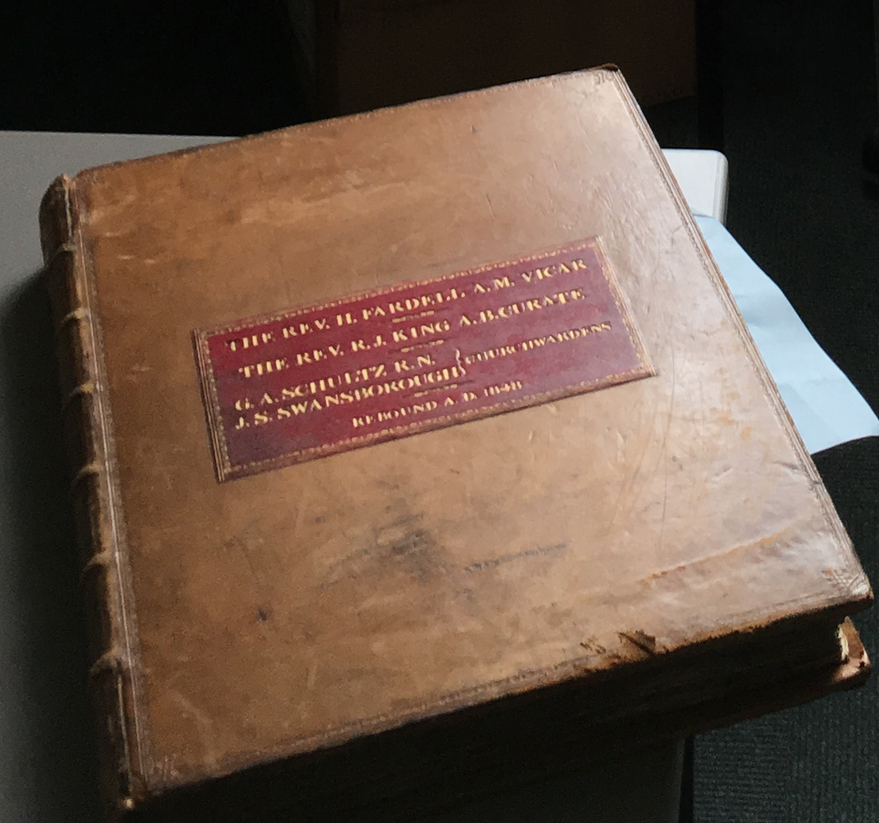
The leather-bound parish records for St Peter’s Church, Wisbech in which I found the first reference to Robert Hubbleday in 1716. The book is preserved in the town’s museum.

Robert and Elizabeth Hubbleday lived in Wisbech all their lives and had eight children between 1717 and 1735. Four of their five daughters died young and the record of their burials in the parish register sometimes notes that Robert is a ‘labourer’.

The record of the burial of one of Robert’s daughters, Elizabeth, on January 3rd, 1727 indicating that he is a labourer.

This is all that we know about him except that he died in 1758 and was buried in the churchyard at St Peter’s where he had married. The term ‘labourer’ is clearly not specific about the nature of Robert’s work but he might well have been involved in the huge, labour-intensive operations to drain the fens. This work had started in earnest in the seventeenth century when the Duke of Bedford had brought over the brilliant Dutch engineer, Cornelius Vermuyden. Alternatively, he might have worked at the port of Wisbech unloading ships or, quite simply, been an agricultural labourer.

The churchyard at St Peter’s, Wisbech where Robert Hubbleday was buried in 1758.

One of his daughters, Anne, lived long enough to marry, as did his three sons, who all went on to have families of their own. However, the survival of the Hubbleday name remained precarious despite the three sons having fifteen children between them. The name soon disappeared from the area as all three sons, William, Robert and John, moved away from Wisbech and the only other Hubbleday family, who lived in Elm, failed to produce any healthy males.

A simplified family tree for Robert and Elizabeth showing the four children who reached maturity. Interestingly, the name Robert is used in every generation but one over a span of 150 years between the 1690s and 1851. It was then another hundred years before another Hubbleday was given the name. That Hubbleday was me although there was no family knowledge at the time of its significance.

Robert and Elizabeth’s youngest son, William, left Wisbech for Southwark, London and married Ann Perry in 1763. The marriage is interesting because William signed a marriage bond testifying that there was no impediment to the marriage. This was a device used to avoid having to attend church on four Sundays to hear the banns being read, for instance, if the couple were in a hurry to marry. They remained in London for the rest of their lives but in 1768 one of their children, Maria, was born in Wisbech, presumably while her parents were back visiting friends or relatives in the town. Although Maria had two brothers, William and Luke, there is no trace of them ever marrying.

Part of the marriage bond which allowed William Hubbleday and Ann Perry to marry without the banns being read. Their marriage took place at the church of St George the Martyr, Southwark in April 1763.

Robert, the middle son, did not go far from Wisbech but he crossed from Cambridgeshire into Norfolk when, in 1748, he married Elizabeth Stanham from Tilney St Lawrence. This was a small village halfway between his parents’ home in Wisbech and King’s Lynn. They settled in the village and had five daughters but only one son, who died as an infant.

John, Robert and Elizabeth’s eldest son and my sixth-great-grandfather, also moved to Norfolk. He had been born in 1719 but, confusingly, only baptised ten years later when his sister, Anne, was being baptised.

The unusual entry in the parish register of Wisbech St Peter recording the baptism of John and his sister Anne on the 14th January 1729 and noting that John was born ten years earlier in 1719. The entry reads: “John son of Robert and Elizabeth Hubleday Born January 1st 1719 and ye same day Anne daughter of ye said Robert and Elizabeth Hubleday.”

He married Mary Witten in 1744 and had three children in Wisbech before moving to King’s Lynn, where he had two sons. The continued existence of the Hubbleday name came to depend on these two boys and it is their very different fortunes which will feature in the next blog.

Addendum to the William Hubbleday Ward story

Since publishing the account of William Hubbleday Ward, I have discovered that his home, Carrington House, is now owned by James Dyson, the British inventor. He doesn’t live there but his company, Beeswax Dyson, owns the Carrington Estate in which it stands. The house is rented out to private tenants.

Carrington House, where William Hubbleday Ward lived for forty years until his death in 1911.

William Hubbleday Ward: a prominent Victorian landowner and local politician in Lincolnshire

Delving into the archives of old newspapers is a fascinating way to research your ancestors and has become much easier since the advent of online digitised records. A general search for ‘Hubbleday’ in the British Newspaper Archive will reveal over 30 mentions of the name up to the early years of the twentieth century and the vast majority relate to one man: William Hubbleday Ward who was born a few years before Queen Victoria came to the throne and lived near Boston in Lincolnshire. Here are some examples of the newspaper references to him:

A sample of the numerous references to William Hubbleday Ward revealed by a general search for the name ‘Hubbleday’ in the online records of the British Newspaper Archive.

William Hubbleday Ward is interesting because of his involvement in local affairs and because, as far as I know, he was the richest Hubbleday there has ever been. He also has the distinction of having married two sisters from the same family at a time when it was technically illegal and certainly frowned upon by the Church. For a long time, however, I was unable to find why William Ward had been given Hubbleday as a middle name.

The 1830 baptism record from Algakirk, near Sutterton, which clearly shows how Hubbleday has been used as a middle name for Joseph and Lydia Ward’s son, William.

The problem was only solved when I managed to trace his roots back to his maternal grandmother, Hannah Hubbleday. The reason this had been so hard to track down was that her marriage had taken place in Little Munden, Hertfordshire, a county which has no other connection with the Hubbleday family.

The church record from Little Munden in Hertfordshire showing (on the bottom line) the marriage of Thomas Archer to Hannah Hubbleday in 1792. This record of William Hubbleday Ward’s grandmother was the final bit of the jigsaw which solved the puzzle about his middle name.

I have not been able to find Hannah’s parents as, sadly, there appear to be no baptism records for her. My strong hunch is that she was a daughter of one of the Lincolnshire Hubbledays who had, perhaps, gone to Hertfordshire as a governess or as a companion to a distant cousin. My supposition is based on the fact that within a few years of her marriage she had left Hertfordshire and was living in Brothertoft near Holland Fen, Lincolnshire. It would be too much of a coincidence that someone from a small village a hundred miles from Lincolnshire would find herself living in this remote part of the country inhabited by other Hubbledays unless she already had a connection with the area.

Hannah and Thomas Archer had two children. Their first was a son born in 1797 and baptised in Great Marlow, Buckinghamshire, perhaps indicating that Thomas’s job required him to move around the country. They named their son William Hubbleday-Archer but we know nothing else about him except that he died when he was only 23 and was buried in Boston, Lincolnshire. Hannah and Thomas’s second child was a girl, Lydia, born in Brothertoft, Lincolnshire in 1803. In 1829, when Lydia was in her mid-twenties, she married Joseph Ward, a successful local farmer at Algakirk, Sutterton, six miles south of Boston. Their first child, born in 1830, was William Hubbleday Ward.

A simplified tree to show how the name Hubbleday was used to name children in successive generations, firstly by Hannah and then by her daughter Lydia.

The Wards were a well-to-do family of local farmers and William had a good start in life. In addition, he probably inherited money from his grandmother’s side of the family as there were no other relatives from her marriage to Thomas. By the age of 20, he was living in his own property in West Ville with two of his sisters and a servant. The 1851 Census lists his occupation as ‘farmer’s son’ and his father, at this time, was farming 1180 acres.

The 1851 Census shows William Hubbleday Ward, aged 20, living as the head of a household consisting of two of his sisters and two servants.

In the same year as the census, a notice appeared in the local paper making clear that father and son were sharing responsibility for their numerous holdings of land.

William and his father were signifiant land owners by 1851.

By the time of the 1861 Census, when William was 30, he was farming 430 acres in his own right in Thornton le Fen and employing eight men. In the summer of 1865, he married Mary Ann Quincey, the daughter of a miller and baker from Kirkby Underwood in Lincolnshire. She came from a very well-connected family who could trace their line back to twelfth century knights, one of whom, Sir James Burton from Tutbury Castle, accompanied Richard I on his crusade to the Holy Land. In more recent times, her grandmother had married a Lincolnshire surgeon and their eldest son, Thomas, inherited Buckminster Hall in Billborough, Lincolnshire from his uncle. Two of Mary Ann’s nieces, Florence and Beatrice Perry, were leading singers with the hugely popular D’Oyly Carte Opera Company. One of her cousins, Colonel Albert de Burton, commanded the 4th Battalion of the Lincolnshire Regiment. William Hubbleday Ward had entered a different social circle and, commensurate with his new standing, his marriage took place in London where his wife’s family had property.

The couple became parents in 1868 when Gertrude Mary was born but there were no further children and Mary Ann was probably in poor health as she died five years after her daughter was born. Shortly before her death, the family had moved into Carrington House in the village of that name. It still stands and is a listed building in private hands. It appears that one of Mary Ann’s sisters, Cecilia Christiana Clifton Quincy, came to live at Carrington House to look after the now motherless Gertrude. In the 1881 census, Cecilia is recorded as a housekeeper and governess alongside a cook, a housemaid and a groom.

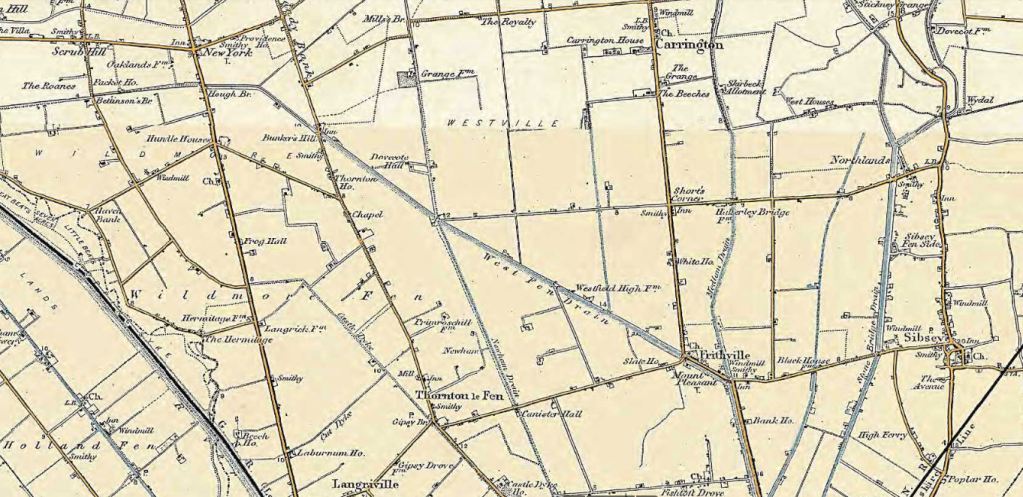
A map from 1904 showing many of the places associated with William Hubbleday Ward. His home at Carrington House is at the top of the map; the area of West Ville, where he lived with his sisters, is in the centre; Thornton le Fen, where his father lived, is in the centre at the bottom; Sibsey, where he was Chairman of the Council, is on the right of the map.

The 1881 census also records that William Hubbleday Ward’s land ownership had vastly increased and he was now farming 1600 acres. From this time onwards, he became increasingly involved in local administration and politics. In 1876 he had been appointed overseer for Thornton le Fen, an unpaid role in the parish to do with the financial administration of dealing with paupers. In the 1880s, he served on a Grand Jury at the Quarter Sessions in Grimsby and in the 1890s he became a Justice of the Peace and Chairman of Sibsey Rural District Council.

Wiliam Hubbleday Ward’s election statement on the front page of the Stamford Mercury in 1888.

In 1893, there was a development in William’s personal life which would have set tongues wagging. He married his deceased wife’s sister, Christiana, who was sixteen years his junior and had been living at Carrington House as his housekeeper. The marriage took place at St Georges, Bloomsbury near where her widowed mother was living. Church law had always forbidden marriage with a wife’s sister and this was enshrined in secular law in the 1835 Marriage Act. It was not until the ‘Deceased Wife’s Sister’s Marriage Act’ of 1907 that it became lawful so it was a bold action on the part of William and Christiana. Their marriage did not produce any children and they continued to live at Carrington House until William’s death in 1911 at the age of 81.

The announcement of William Hubbleday Ward’s death in 1911.

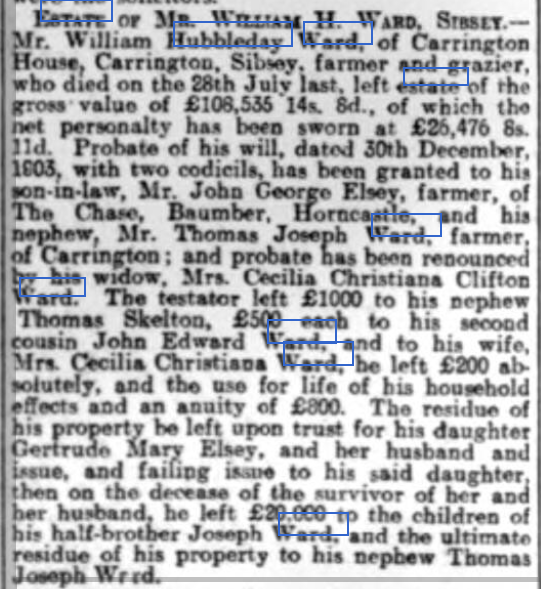
William was a very wealthy man when he died. His executors held a number of sales of livestock and machinery at his various farms and the probate records reveal that his estate was worth over £100,000. In today’s money he would be a millionaire several times over. His daughter and wife were left substantial sums but the major beneficiary was his nephew, Thomas Joseph Ward.

The details of the will were outlined in The Stamford Mercury.

Thomas Joseph Ward probably inherited some of the farmland and went on to build an even bigger reputation than his uncle’s. At the time of his death in 1944, he was farming 7,000 acres and employing over 200 men. It is clear from the obituary which appeared at the time that a significant farming and local political dynasty had been built from the foundations laid by William Hubbleday Ward.

Part of the 1944 obituary for Thomas J Ward, the nephew who benefited from William Hubbleday Ward’s will. It refers on the last line to the tradition of public service started by William.

Unfortunately, I am not able to prove conclusively that 21st Century Hubbledays are related to William Hubbleday Ward. However, I believe that his grandmother, Hannah Hubbleday, was likely to have been born into one of the Hubbleday farming families scattered around Lincolnshire in the 18th Century. William and Lydia Hubbleday in East Kirkby, for example, would be a strong possibility. They were raising a family in the 1760s which would fit the timescale for Hannah’s marriage in 1792. Hannah’s two children were called William and Lydia so that would also fit with the common practice of retaining family names. It is a reasonable hypothesis that all of the Hubbledays in Lincolnshire have a common ancestor and that we too belong to that family. I cannot provide documentary evidence but if these suppositions are true, William Hubbleday Ward would be something like a fifth cousin seven times removed!

You may be relieved to know that in the next instalment of this blog, I will reveal our earliest confirmed direct ancestor and will begin to describe the journey our genes have made over the last three centuries from rural East England to the industrial Midlands.

The Lincolnshire Hubbledays in the 17th and 18th Centuries: from Fenmen to Farmers

There are approximately 80 Hubbledays mentioned in church records of baptisms, marriages and deaths in Lincolnshire between 1608 and 1801. This is the largest number of Hubbledays in one county but there appear to be no more than three or four separate branches of the family in existence at any one time. All of these Hubbledays worked the land, usually as poor agricultural labourers or as self-sufficient owners of smallholdings. In a county famous for its flat, low-lying landscape of peaty marshes, some evocatively and, no doubt proudly, called themselves ‘fenmen’. Occasionally, some of their descendants did even better for themselves and became prosperous farmers.

The entry for William Hubbladay’s burial in 1740 reflects his description of himself in his will as a ‘fenman’.

It is highly likely that these Lincolnshire Hubbledays were relatives of the Hubbledays living on the north side of the Humber estuary in East Yorkshire from the fifteenth century. As the name gradually disappeared from Yorkshire at the end of the seventeenth century, it began to flourish in the neighbouring county south of the Humber. The name was frequently spelled as ‘Hubbladay’ or ‘Hubladay’ but there was often no consistency even in the same family and sometimes it appears as ‘Hubleday’ and occasionally as ‘Hubbleday’. The earliest written record of the name in Lincolnshire is on Christmas day 1628 when Elizabeth, the daughter of John and Mary Hubleday, was baptised in East Kirkby. Hubbledays continued to live in this village and the surrounding area for the next hundred years or so. Another part of the county where they settled was around Swineshead, further to the South.

Lincolnshire nestles beneath the River Humber and extends to the south-western edge of The Wash. East Kirkby, the village which was home for many Hubbledays in the seventeenth and early eighteenth centuries, is shown by the star near Horncastle.

East Kirkby is now famous for its aviation heritage centre on the site of the 1943 former RAF bomber command station. Three hundred years earlier in 1643, it played a small part in another war when its church was used as a stable by Oliver Cromwell’s cavalry on the night before the Battle of Winceby. It is recorded as a matter of regret that the horses chewed the ends of the pews! John and Mary Hubbleday had four children baptised in this church in the 1640s and might well have seen Oliver Cromwell pass through their village.

East Kirkby (or Kirkby East as it is labelled) can be seen in this early 18th Century map on the left edge of the Bullingbrook Wapontake. It is on the same line of latitude as Skegness on the East coast. A ‘wapontake’ was the old northern name for an administrative district similar to a ‘hundred’ in Anglo-Saxon shires further south.

John and Mary’s youngest son, another John, married Ann Watson in 1685 after the death of his first wife and they had three daughters and three sons. Three of the children died in childhood but two of the sons lived long enough to write wills which are of considerable interest. The older son, Thomas, died in 1715 quite soon after his marriage and did not have any children. He was 27, living in Sibsey and described himself as ‘a labouring man’. He left a shilling to his brother William and the rest of his estate to his wife. His goods and chattels amounted to £53 and consisted mainly of farm animals and equipment. This was no small sum for a young man in those days and indicates that he was probably better off than many of his neighbours.

John and Mary’s two sons moved only a few miles away from where they had been born. Thomas lived in Sibsey and William lived in Toynton St Peter.

William, the brother who inherited a shilling, was born in 1692 and lived much longer than Thomas. He wrote his will in 1736 and died in 1740 when he was 48. His will is far more detailed than his brother’s and provides excellent evidence of his family tree. He lived at Toynton St Peter, three miles from East Kirkby and described himself as a fenman.

He left his house, land and all of his belongings to his wife Sarah with the provision that as soon as any of his four children married, the land should be sold and the proceeds divided between his heirs: ‘my three children by my late wife and and my daughter Sarah by my present wife. I will that they have ten pounds apiece of ye said money.’ He goes on to say that his wife should have whatever is left over and that the ten pounds each child receives should be ‘put out to interest at the discretion of their two uncles, John Prentice of Toynton and John Spiking of Stickforth‘. These names neatly corroborate the church records about the family so that we can be certain that the following tree is accurate.

This is the family mentioned in William’s will of 1736. There are six children rather than four because it shows Ruth who died in the same year as her mother, Mary Spiking, and a son, John, born in 1739 after the will was written.

After William’s death in 1740, an inventory was drawn up according to the law at the time. Two of the four signatures on it belong to the uncles mentioned in the will: John Spiking and John Prentice. William’s belongings are listed as: his purse and apparel (£5); three cows and a calf (£10); one horse (£4); eight kade lambs (£2); hay and fodder (£4); corn in straw (£2); two beds and other things in the parlour (£3); and two tables and other things in the house (£3). It amounted to £31, which is a surprisingly small figure compared with his brother’s inventory. However, it does not include the value of the house itself or the land.

The first part of William Hubbladay’s inventory after his death in 1740. A kade lamb is one without a mother.

We don’t know what happened to Mary and Thomas, two of William’s three children by his first wife. The third child, William, born in 1727, remained in East Kirkby, married twice and had eight children, three of whom died in infancy. When his first wife died in 1750, soon to be followed by the baby she had given him, the parish record describes him as a labouring man aged 31. He died in 1767 having had only one son, another William, and it is not certain what happened to him. He may have been the William Hubbleday employed by the East India Company as a soldier who died at Fort William in India in 1789. The fourth child mentioned in the will was Sarah. She married William Coats in Toynton All Saints and remained in the area to raise a family.

It was the fifth child, John, who was born in 1739 after the will was written but a year before his father’s death, who was most successful. He secured his family’s fortune by becoming a prosperous farmer. At the age of 21 he became the tenant of Monk’s Farm in Brothertoft, ten miles south of East Kirkby. The land was owned by Sir Charles Frederick and a copy of the lease is held at the Surrey History Centre among his family’s papers. In May 1765, John married Jane Ranby in nearby Boston and they had eight children but only three daughters managed to survive childhood. Jane lived to the age of 74 and her gravestone can still seen in the churchyard of St Mary’s, Swineshead.

A detail from Jane Hubladay’s gravestone in St Mary’s, Swineshead. She died in 1819.

It was during John and Jane’s tenure at Monk’s Farm that the landowners began to drain and then enclose large areas of fenland. The ordinary inhabitants of Brothertoft were fiercely opposed to the enclosure of nearby Holland Fen which they used for fishing, wildfowling and recreation. There were violent riots in 1767 which required Sir Charles to employ an armed guard for the area.

However, John did well out of the land improvements. The reclaimed fens were hugely productive and were at the cutting edge of the agricultural revolution in the eighteenth century. When John died in nearby Swineshead in 1801, he was a rich man. The probate documents held in the National Archives list him as a farmer who left legacies amounting to £5,000. At the time, the average yearly wage of a labourer was under £20. His married daughters, Elizabeth and Mary, inherited the proceeds from property sales; his wife, Jane, received £1,000; his unmarried daughter, Sarah, who was still a minor, received £2,000 to be held in trust until she was 21; his nephew, Christopher Coats received £400; and his granddaughter, Jane, was given £300.

This tree shows John Hubladay’s immediate family and the relatives who inherited his wealth.

From the contents of the will and the details of the family tree in the diagram above it can be seen that there was no male line of Hubbledays to whom the considerable estate could be left. Somewhat surprisingly, however, the name lived on in this branch of the Hubbledays for several more generations as several descendants were given it as a middle name.

The most prominent was Elizabeth and Nicholas Booth’s son who was christened John Hubbleday Booth in honour of his prosperous grandfather. Sadly, he seems to have spent the family’s money unwisely and he attained notoriety in the area for his dissolute life. An obituary in The Baptist Magazine of 1820 painted a lurid picture of someone whose ‘whole life had been filled up with the pleasures of sin, and the carnal conversation and company of an ungodly world’. The writer of the obituary noted that a letter he had written anonymously to Mr J Hubbleday Booth exhorting him to mend his ways had been met with contempt until illness and imminent death at the age of 30 had reformed his character.

The beginning of a striking obituary from The Baptist Magazine of 1820.

Nicholas Booth and Elizabeth also had a daughter, Mary, born in 1792. She married William Hides (presumably a relative of her Aunt Mary who had married John Hides) and, rather oddly, used ‘Hubladay as her son’s first name.

The use of the name ‘Hubleday or Hubladay by three generations of Elizabeth’s descendants presumably indicates the gratitude they felt for the wealth they had inherited from John Hubladay who died in 1801.

Hubladay Hides, born in 1815, had an elder sister, Elizabeth Ann, who married Isaac Flatters, a labourer, and they named their first son John Hubladay. When he died, aged 15, they used the name again for their next son in 1849. This John Hubladay Flatters lived until 1914.

The parish record of the baptism in 1849 of the second John Hubladay Flatters.

Christopher Coats, the nephew who had inherited £400 from his uncle in 1801, married Eleanor Ranby (presumably a relative of his aunt Jane Ranby) and, in 1815, named a son John Hubleday Coats. They had had another son, Edward, in 1799 and he chose not to give the name ‘Hubbleday’ to any of his children. However, remarkably, one of his granddaughters was given the name in 1889, nearly a century after the death of her only link with the Hubbleday paternal bloodline. She rejoiced in the name of Edith Isabel Hubladay Coates. In 1911, she was working as a live-in nanny and governess to the children of a land agent in Aswarby in Lincolnshire. Not long afterwards she married William Strawson and emigrated to Canada. She lived until the age of 93 and was buried in 1982 in Alberta, Canada. One cannot help but wonder if her family ever discovered why she had such an unusual middle name.

Edith Isabel Hubladay Coates was the great, great, grandchild of John Hubladay’s sister, Sarah Hubbladay, born in 1735. Edith died in 1982, breaking a link which had honoured John Hubladay’s memory for nearly 200 years.

The use of Hubbleday as a surname had dwindled into virtual non-existence in Lincolnshire by the beginning of the nineteenth century. It is salutary to note that around two-thirds of the children born into Hubbleday families in the previous two hundred years never made it into adulthood. Of the sixteen male Hubbledays in Lincolnshire for whom we have both birth and death dates, only half lived long enough to marry. With such a small base of males bearing the name to begin with, it is not surprising that it remained a rare surname.

Weddings

This is a rather different blog to the previous ones. My intention remains to write a chronological history of the family name but I have decided that June 2019 deserves something special. The reason for this is that my branch of the family has celebrated two weddings within the space of three weeks.

At the beginning of the month, my brother Brian’s son, Michael, married Chrissi Renner in Germany and yesterday, my own son, David, married Emily Lloyd in Shropshire. We now have two new Mrs Hubbledays to augment our numbers!

Brian Hubbleday with new daughter-in-law, Chrissi, son Michael and wife Jill.

Chrissi is from Germany but met Michael in England when they were both working as technical writers at Delcam in Birmingham. They moved to Germany a few years ago and, as far as I am aware, they are the only Mr and Mrs Hubbleday living outside the UK.

The new Mrs Emily Hubbleday with my son, David.

David and Emily live in Cheslyn Hay near Cannock. Emily is a Human Resources Manager for an American company with a factory in Dudley. David owns and runs two internet companies: snowbus.co.uk and snowcompare.com, which both focus on snowboard and skiing transfers from European airports to the Alps.

Both weddings were wonderful family occasions. The oldest person attending my son’s wedding was my mother, Renee Hubbleday, who is 94. The youngest was my brother’s grandson, Arlo Hubbleday, who is not yet one.

Four generations of my father’s branch of the family, with our two new brides, Emily and Chrissi.

The earliest photograph I have of a Hubbleday wedding dates from 1907. This is the wedding of my grandfather, Charles William Hubbleday, to Emma Allen in Aston, Birmingham. Charles was a metal spinner in a silversmiths. Emma was the youngest daughter of a carpenter from Warwick. They were both aged only 18 when they married.

Emma Allen and Charles William Hubbleday either shortly before or after their wedding in 1907.

Charles and Emma went on to have a large family of ten children, five boys and five girls. They celebrated their Golden Wedding Anniversary in 1957 and I have every hope that the year 2069 will also see some Golden Wedding anniversaries.

Golden Wedding Celebration at Greenwood Avenue, Acock’s Green in 1957. Kneeling: Eric and Albert; Front Row: Doris, Emma, Charles, Hilda; Back Row: Ivy, Margie, Gordon, Gladys, Charles, Ken.